| |
Burke Airport FAQs:
A citizens' perspective
The following is a sample of the conclusions from a 2002 report on Cleveland's Burke Lakefront Airport commissioned by the BLUE Project. For more detailed information on the history and status of the airport, follow the links at right to the full report. [Update in 2007: Please note that some of the facts presented may be out of date, but the scenarios the bottom of this page still offer a good summary of possible futures for Burke.]
Who owns and controls Burke?
This seems like a simple question, but the answer is complicated. The airport is built in Lake Erie on filled land. The State of Ohio maintains a public trust interest in the bed of Lake Erie under the airport, while the City owns the fill and the airport buildings and facilities. The City should have a submerged lands lease from the state allowing it to use the lake bed for airport uses, and the state should have to give permission to change those uses. In addition, there is a provision of the City Charter that may require a vote of the citizens to approve the sale of Burke land to private interests.
Who uses Burke?
Last year, Burke had about 92,000 flight operations (every take-off or landing is one operation). For perspective, that's about one third of the operations at Hopkins Airport. Who made those operations? According to the breakdown we've seen, a large portion of total flights were made by small, single-engine planes based at the airport and by helicopters, such as those used by TV news. There are four flight schools at Burke, and one student flight can generate many operations, including several "touch-and-goes."
Only 4 jet aircraft are based at Burke. In contrast, Cuyahoga County Airport has 81 jets. Thus, County seems to have much more corporate jet business.
How does Burke fit into the regional air transportation system as a reliever airport?
No one wants all those student pilots and other general aviation flights competing for runway space with commercial airlines at Hopkins. So it's important to have a regional system of reliever airports, such as Burke, Cuyahoga County, Lorain County, Lost Nation, and others. If Burke were to close, no one really knows where its current business would go, but much of the business could be accommodated at these other reliever airports. The flights wouldn't necessarily be forced on Hopkins. However, there are more concerns about airplane noise at other airports, and Burke has some better facilities than other reliever airports.
Is Burke an amenity for downtown businesspeople?
An argument often made for maintaining Burke as an airport is that it lures corporate headquarters to downtown Cleveland. We have found no independent study to document this (although many business surveys point to the importance of convenient air travel in general as vital for the economic competitiveness of Northeast Ohio). Indeed, if the slumping downtown office market is any indication, Burke has not been much of a draw. Instead, it seems that a lot of corporate traffic is out at the County Airport or Akron-Canton. That makes sense when you map the suburban locations of high-income households, such as the I-271 corridor. The regional market for air travel is moving away from Burke.
One wild card in the corporate flight situation is the impact of 9/11. Private flying could increase, and there are reports of increases in the fractional ownership of jets. On the other hand, air traffic in general is still depressed since 9/11, and people may be finding alternatives to flying, such as videoconferencing, van limos, or trains.
Does Burke pay its way?
In a strict sense, no. In recent years, Burke's income has covered only about half of expenses, with the annual deficit running about $1 million to $1.4 million a year. This deficit is paid by the users of Hopkins Airport (not the City's general fund) because the airports work from the same "enterprise account" within the City budget. All Burke maintenance, operation and administrative expenses, and all rentals, charges, landing fees, use charges and concession revenues, are included in the calculation of airline rates and charges for Hopkins Airport.
Airport officials argue that the subsidies from Hopkins are okay, however, because it's reasonable for a major airport to subsidize a reliever airport as part of regional system.
Would the Federal Aviation Administration allow Burke to close?
Certainly, the FAA hates to see an airport close. But we have found no absolute law that says Burke can't close. It seems to be more of a political issueand a matter of making other changes to the regional air system.
It's also claimed that the City would have to repay the FAA huge sums for federal investments at Burke if the airport closed. The exact amount is another murky issue, but Prof. Ned Hill of CSU's College of Urban Affairs, who has studied local airports, estimates the amount to be only about $7 million. He adds that a good argument could be made that the City could avoid a one-time payment if a sensible regional air system plan can be worked out.
How should one evaluate the value of Burke?
Airport officials and many others see Burke as an essential part of the regional air system, which in turn is essential for economic growth. But what if the question is what is the best use of Burke's 480 acres of lakefront land to stimulate the downtown real estate market and build the tax base of the City? The airport doesn't seem to have had much impact, so it's possible that other usesa park, a new urban residential villagewould be more of an amenity that would bring people back to the city and give downtown a competitive edge over suburban office locations. An objective economic study of these alternatives needs to be done.
Can a bike path be built around the perimeter of Burke to provide access to the lake?
Citizens have identified public access to the lake as a top priority, so it would be great if access could be provided around the perimeter of Burke. With the airport's current runway configuration, this would be difficult to accomplish because of the FAA's concerns for security and safety. However, we've found no definitive ruling on the possibility.
What are the possible scenarios for Burke?
There are at least 5 possible scenarios for the airport to consider, each with pros and cons:
1) Status quoKeep the airport as is, not realizing it's full potential and not exploring other uses. This is the least appealing alternative.
2) Keep the airport and improve it so it can offer more services and be a more important part of the regional air system. This is the direction of the current airport plan, which includes a new runway, more hangers, and other facilities.
3) Close the airport and create a park. The site could be a huge, waterfront open space, but it's not well connected to a residential neighborhood. Would it be used? Another question is whether soil remediation would be required to permit park uses. To date, testing has found the soils at Burke to be comparable to other urban soils with moderate levels of pollution.
4) Close the airport and develop the land as a new urban village with green space and public access to the water. This raises questions about the suitability of the fill for building. While the fill material (composed of dredgings and municipal garbage) hasn't been found to be very hazardous, there are geotechnical issues that need to be studied. It would also be important to build residential products that don't compete with other downtown housing.
5) Keep the airport and move the Port Authority to the east end of it, creating a multi-modal facility that would consolidate air, water and rail operations at a location with good highway connections. That would be costly, but it would open up exciting lakefront development opportunities close to the Warehouse District and downtown. Such development could be served by the existing RTA Waterfront line.
Back to top
EcoCity Cleveland
3500 Lorain Avenue, Suite 301, Cleveland OH 44113
Cuyahoga Bioregion
(216) 961-5020
www.ecocitycleveland.org
Copyright 2002-2004
|
|
Back to main BLUE Project
Burke Lakefront Airport: A report on its history, current status and future
Download Word document version (203KB)
Download PDF version (661KB)
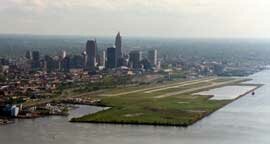
Burke Lakefront Airport off downtown Cleveland
Chicago demolishes Meigs Field
|
|